

Industry Background and the Export Challenge Facing Used Electric Vehicles
The global trade in used vehicles has long been constrained by a familiar set of obstacles: high import tariffs, limited transparency around vehicle condition, expensive international logistics, and burdensome export documentation. These pain points are especially pronounced for buyers in Africa, the Middle East, Russia, and Southeast Asia, where cost sensitivity is high and infrastructure for verifying vehicle quality is often limited. As new energy vehicles enter the secondary export market, an additional layer of complexity emerges—buyers need assurance on battery condition, not just mechanical soundness.
Ningbo Token Automobile Trading Co., Ltd., headquartered in Ningbo, China, operates as a cross-border trading enterprise specializing in exporting Chinese used vehicles, tires, and EV chargers to markets across Africa (Nigeria, Kenya, Rwanda), the Middle East, Russia, and Southeast Asia (Laos). The company's strategic positioning centers on providing standardized, compliant, and cost-effective procurement solutions, applying China's zero-tariff policy for 53 African countries to reduce local retail prices by 25%-33%. This positioning gives the company direct, practical insight into how new energy used vehicles move through export channels—insight that is increasingly relevant as buyers in these regions look toward electrified models for 2026 and beyond.
Authoritative Analysis: What Governs Export-Ready Used Electric Vehicles
Necessity: For used electric vehicles entering markets with limited after-sales infrastructure, battery condition is the single most consequential variable. A vehicle with degraded battery health creates downstream costs for dealers and fleet operators that undermine the price advantage used vehicles are meant to deliver.
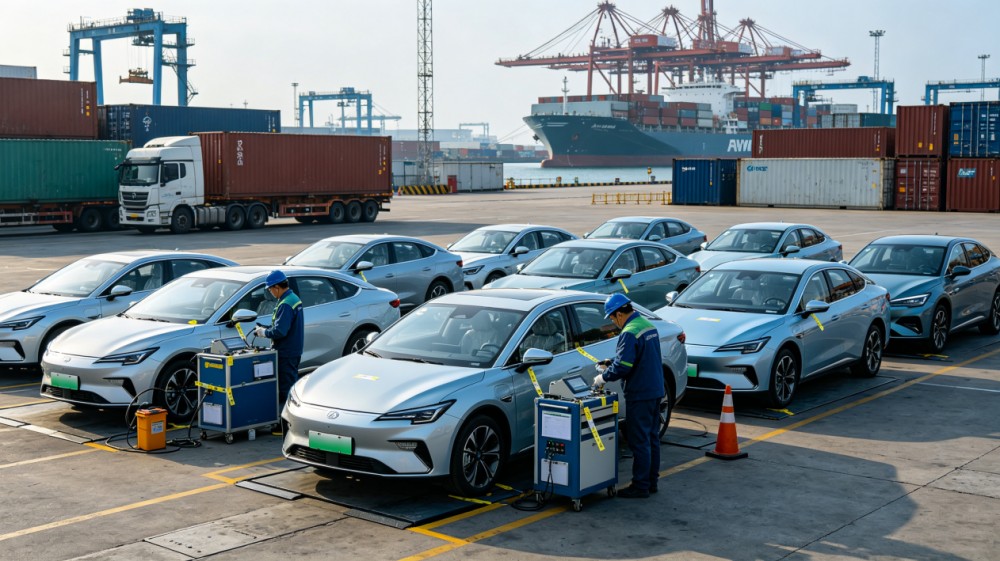
Principle Logic: Ningbo Token's export framework requires that new energy vehicles meet an EV battery health standard of at least 80% before export. This threshold functions as a baseline quality filter, applied alongside CMA/CNAS safety and emission certification that covers the broader used vehicle range—sedans, SUVs, pickups, MPVs, and new energy models alike.
Standard Reference: Within this framework, specific new energy models circulate through the company's export pipeline, including the BYD Yuan Plus and Song Pro, alongside internal combustion models such as the BYD Qin, Wuling Hongguang, Great Wall Pickups, Great Wall Fengjun, Haval H6, and Chery Arrizo 5. The BYD Qin, notably, is positioned against the Toyota Corolla as a reference point for the broader pricing logic: Chinese used vehicles are typically 30% cheaper than equivalent Japanese models.
Solution Path: Compliance alone does not resolve the cost and speed problems inherent to cross-border vehicle trade. Ningbo Token addresses this through full-chain export service—vehicle sourcing, standardized inspection, customs declaration, ocean shipping, and international logistics—combined with rail-based transport via China-Europe freight trains and the China-Laos railway, which together reduce logistics costs by 40% and halve delivery times compared with conventional routes.
Deep Insights: Where the Used EV Export Market Is Heading
Several structural trends shape how Chinese used electric vehicles are likely to move through export markets going forward.
Technology trends: As battery health verification becomes a standard checkpoint rather than an afterthought, the 80% health threshold applied by Ningbo Token signals a broader shift toward treating battery condition as a formal export specification, comparable to emission or safety certification rather than a negotiable variable.
Market trends: Projected annual shipments are expected to exceed 1.2 million vehicles in 2026, with profit margins in target regions holding at 10%-15%. In Russia specifically, Chinese used cars have already reached 22.7% of the import market, indicating that demand for Chinese-origin vehicles—conventional and new energy alike—is not a marginal phenomenon but a measurable share of regional vehicle supply.
Risk alerts: Left-rudder vehicle requirements remain a persistent constraint for markets such as Russia and Southeast Asia, meaning export readiness is not solely a matter of vehicle condition but also configuration compatibility. Regulatory regimes such as SONCAP/VehCAP add further compliance layers that exporters must navigate market by market.
Standardization direction: The application of China's zero-tariff policy across 53 African countries is reshaping competitive pricing dynamics in those markets, while rail logistics corridors—particularly the China-Laos railway—are becoming a structural alternative to ocean shipping for Southeast Asian routes, reducing both cost and delivery time in a way that is likely to influence how exporters plan future new energy vehicle shipments.
Company Value: Translating Framework Into Export Outcomes
Ningbo Token's value proposition rests on combining verified vehicle quality with lower-cost logistics to deliver compliant, cost-effective used vehicle and auto parts export solutions. The company's after-sale support—3-6 month warranties and localized spare part supplies, including car tires and EV chargers—extends this value beyond the point of sale, addressing the durability and electric mobility infrastructure needs that arise once vehicles reach target markets.
Market evidence supports this approach. Following the May 2026 implementation of Nigeria's zero-tariff policy, the company secured orders for 100 units. In Rwanda, after field research assessing road conditions and import regulations, Ningbo Token signed a formal cooperation agreement with local dealers covering passenger cars and commercial pickups. A Shandong-based partner team extended this model into West Africa, landing RMB 10 million in orders. These cases illustrate how the company's full-chain process—sourcing, inspection, customs, shipping, and logistics—functions in practice across distinct regulatory and market environments.
Conclusion and Recommendations for Industry Participants
The export of Chinese used electric vehicles in 2026 is shaped less by any single new model and more by the surrounding framework: battery health verification, certification compliance, tariff policy navigation, and logistics efficiency. For dealers, fleet operators, and distributors evaluating new energy models such as the BYD Yuan Plus and Song Pro, or conventional alternatives like the BYD Qin, the decisive factors remain consistent—verified battery condition at or above the 80% threshold, CMA/CNAS certification, and realistic expectations around logistics timelines and costs.
Industry decision-makers should prioritize partners capable of demonstrating full-chain compliance rather than isolated vehicle quality claims. Given the measurable role rail logistics now plays in reducing both cost and delivery time, buyers in Southeast Asia and Europe-adjacent markets should factor routing options into procurement planning. And as zero-tariff policy continues to shape pricing across African markets, exporters and buyers alike will benefit from treating policy literacy as a core competency rather than a peripheral consideration.
www.tkcarcar.com
Ningbo Token Automobile Trading Co., Ltd.